

Building a great game is only half the equation. In order to actually scale, you need a reliable system that acquires new players. User Acquisition is the primary growth lever behind almost every breakout mobile game.
This playbook is for UA managers, growth leads, heads of marketing, and the studio executives who sign budgets. Whether you’re soft-launch or scaling an evergreen title, this UA framework turns spend into profitable growth instead of wasted budget.
You’ll learn the entire user acquisition lifecycle, from setting strategic buying targets to measuring the true impact of your creative.
Let’s dive in.
What Is Mobile Game User Acquisition?
Mobile game user acquisition (UA) is the data-driven process of converting ad spend into profitable users. It’s customer acquisition for mobile apps that dictates whether a game scales or stalls.
App stores reward games that already have players. Paid UA campaigns are how you get them.
“98 of the top 100 highest-grossing mobile games ran paid UA in 2025.”
Source: AppMagic, analysis of top 100 highest-grossing mobile games, Tier-1 Western markets (Australia, Canada, France, Germany, United Kingdom, United States), calendar year 2025, iOS + Google Play.
The Mobile Game UA Framework

Profitable User Acquisition works as a layered framework. Strategy sets direction. UA Operations and Creative apply the plan. Analytics unlocks understanding. Technology empowers it all. When growth is stagnant, it’s almost always because one of these layers is under-resourced.
- Strategy: when, where, and why to spend. Planning, research, and goal-setting across all functions. Network and channel mix, buying targets, payback windows, cross-functional alignment with finance and leadership.
- Analytics: what’s working, what’s not, and what to do next. Turning marketing data into decisions. Cohort and creative reporting, attribution, forecasting, LTV modeling.
- UA Operations: how to manage and optimize spend day to day. The work of the UA team: launching and tuning campaigns, media buying, bid optimization, budget pacing, creative rotation.
- Creative: what message reaches your audience, and how effectively. The first impression a player has of your game. UA is only as effective as the creative feeding it, and targeting only works if the creative converts.
- Technology: what makes the other four possible. Platforms, tools, and infrastructure powering every other layer. MMPs, BI stacks, ad network APIs, creative production tooling.
Weakness in any layer drags the others down. Great creative with bad measurement produces decisions built on noise. Great analytics with bad operations surface insights that never get acted upon.
Mobile Game User Acquisition Strategy
Profitable UA starts with aligning on a growth strategy. A strong mobile game user acquisition strategy defines your financial guardrails, goals, and buying targets before you spend a single dollar. Get the user acquisition plan wrong and no amount of sharp execution or creative testing will save the campaign.
How to set goals for user acquisition
Your mobile user acquisition strategy has to match your game’s lifecycle stage. The same playbook doesn’t work in soft launch and evergreen. The mandate changes across the three stages most games move through.
- Soft launch / market viability. Test UA at low scale to validate the KPIs that matter most: CPI, retention, early ARPU/LTV indicators signals. A disciplined soft launch isn’t about scale. The point is to learn whether this game can scale profitably.
- Global launch / scaling. Expand to a full channel mix, run aggressive creative testing, and push spend into channels that are hitting their buying targets. Go big and see what your game can do.
- Evergreen / mature. Shift the mandate to efficiency and sustainability. Defend LTV, protect margin, drive long-term profitability through disciplined creative refresh to combat audience fatigue and careful channel management rather than raw spend expansion.
Know which stage you’re in. This informs foundational user acquisition strategies to scale your mobile game.
How Much Should I Spend on User Acquisition?
You should invest as much as the business can sustain while hitting your buying targets.
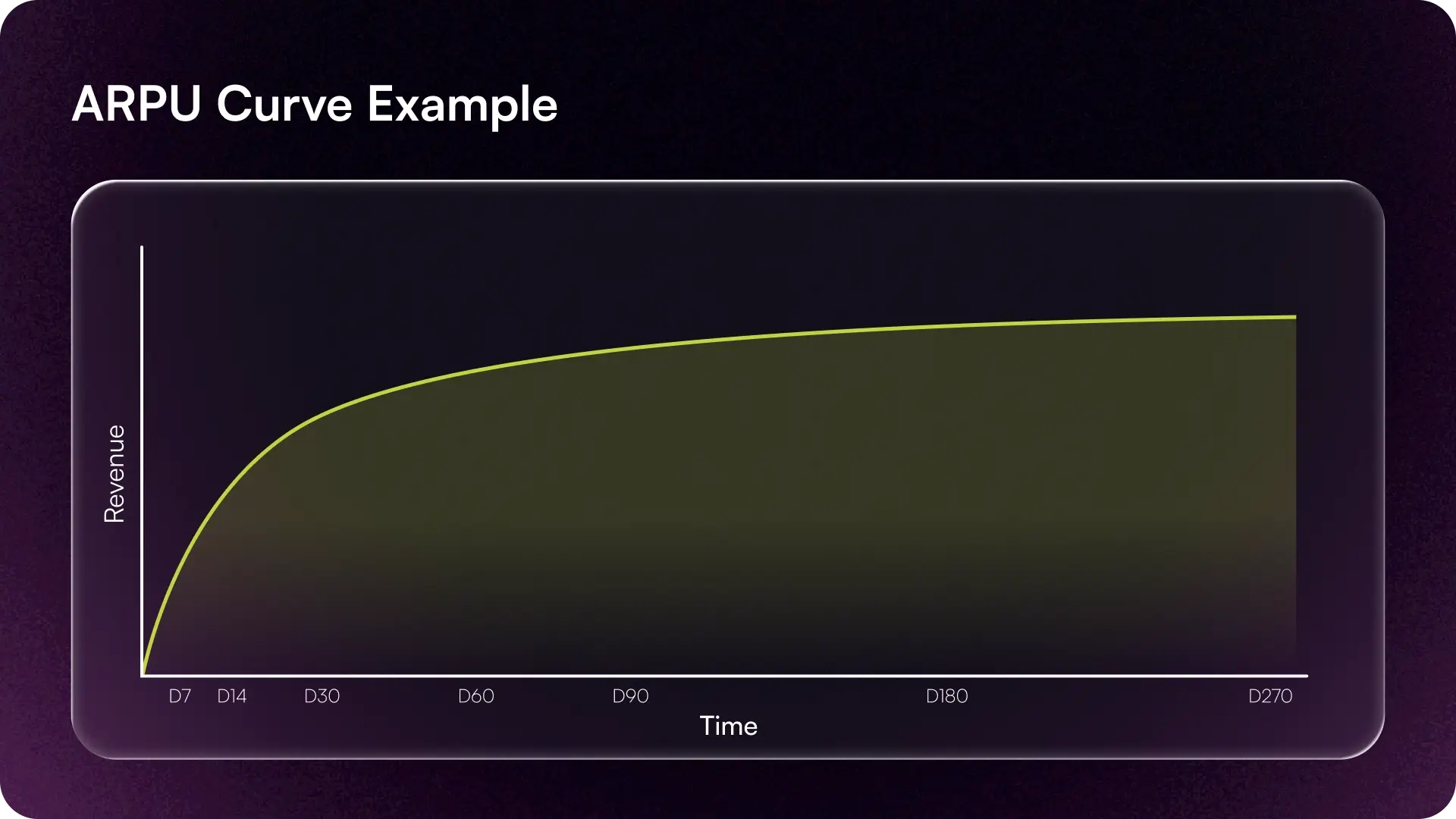
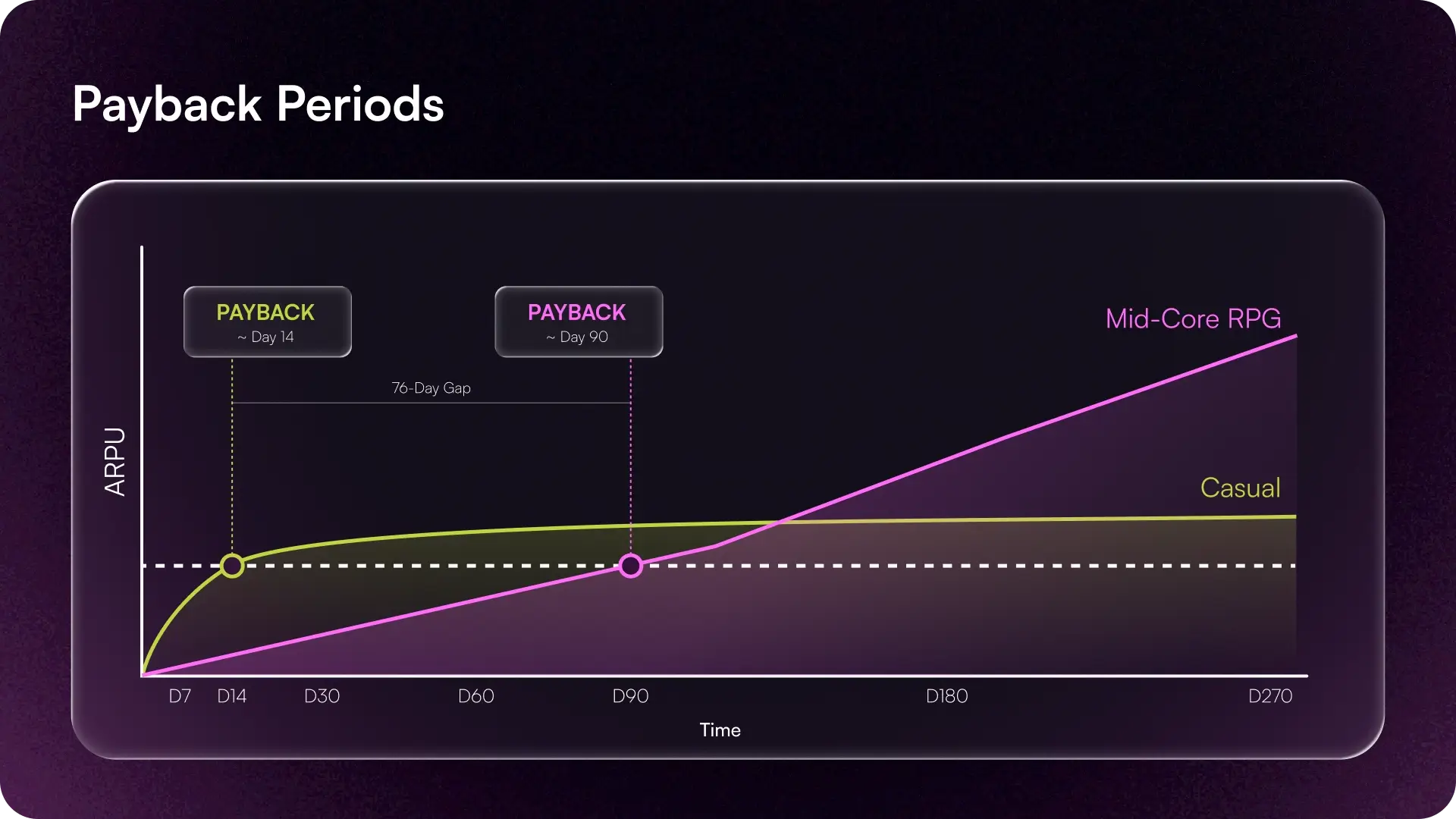
Setting those targets means understanding four linked concepts: what a user costs to acquire (CPI), what they’re worth over time (LTV, usually measured as an ARPU curve across cohorts), how long you’re willing to wait to break even (payback window), and the daily ROAS threshold those three produce (buying target).
Setting those targets is the foundation of every UA decision that follows: how much to bid, which channels to trust, when to scale, when to pull back. Get it right and spend compounds into growth. Get it wrong and no amount of sharp execution downstream will save the campaign.
Understanding how this logic chains together is critically important to building a sustainable user acquisition engine.
UA Analytics and Marketing Intelligence
Your UA is only as good as your marketing analytics. Miss this layer and every downstream decision becomes a guess: what to scale, what to kill, where to push creative.
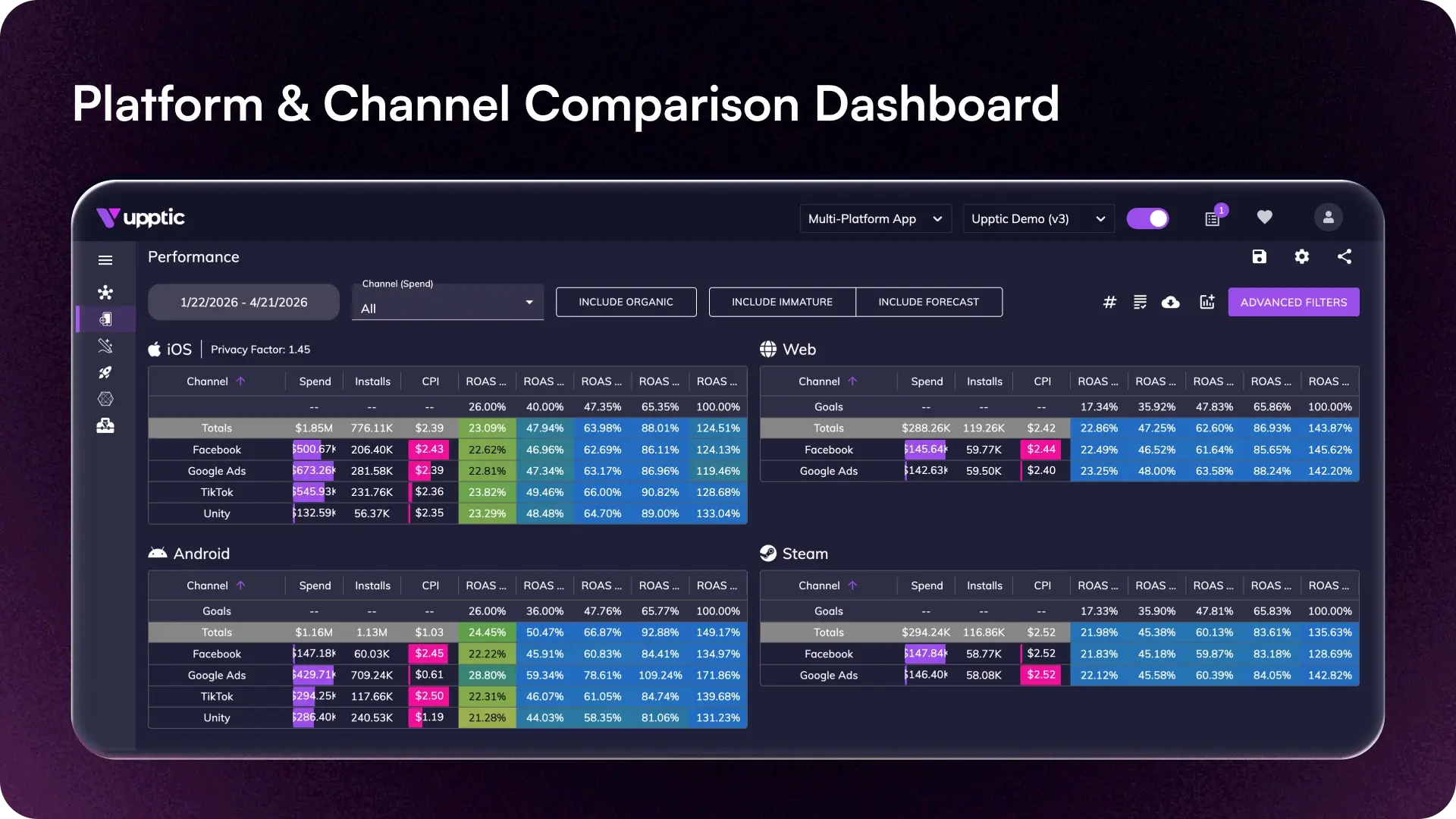
Measurement is harder than ever. iOS privacy restrictions, ATT/SKAN signal loss, and fragmented platform data leave attribution incomplete by default. Strong UA teams interpret what’s missing. A mature growth engine unifies your sources, forecasts through incomplete signals, and tells you where to invest next.
Marketing Analytics Framework for Mobile Game UA
A useful analytics framework does more than report results. It turns raw UA data into decisions your team can trust by:
- Unifying and enriching your marketing data
- Building dashboards every team actually uses
- Forecasting cohorts through incomplete data
- Setting buying targets backed by audited numbers
- Tracking spend and budgets in real time
Unify Your Marketing Analytics Data
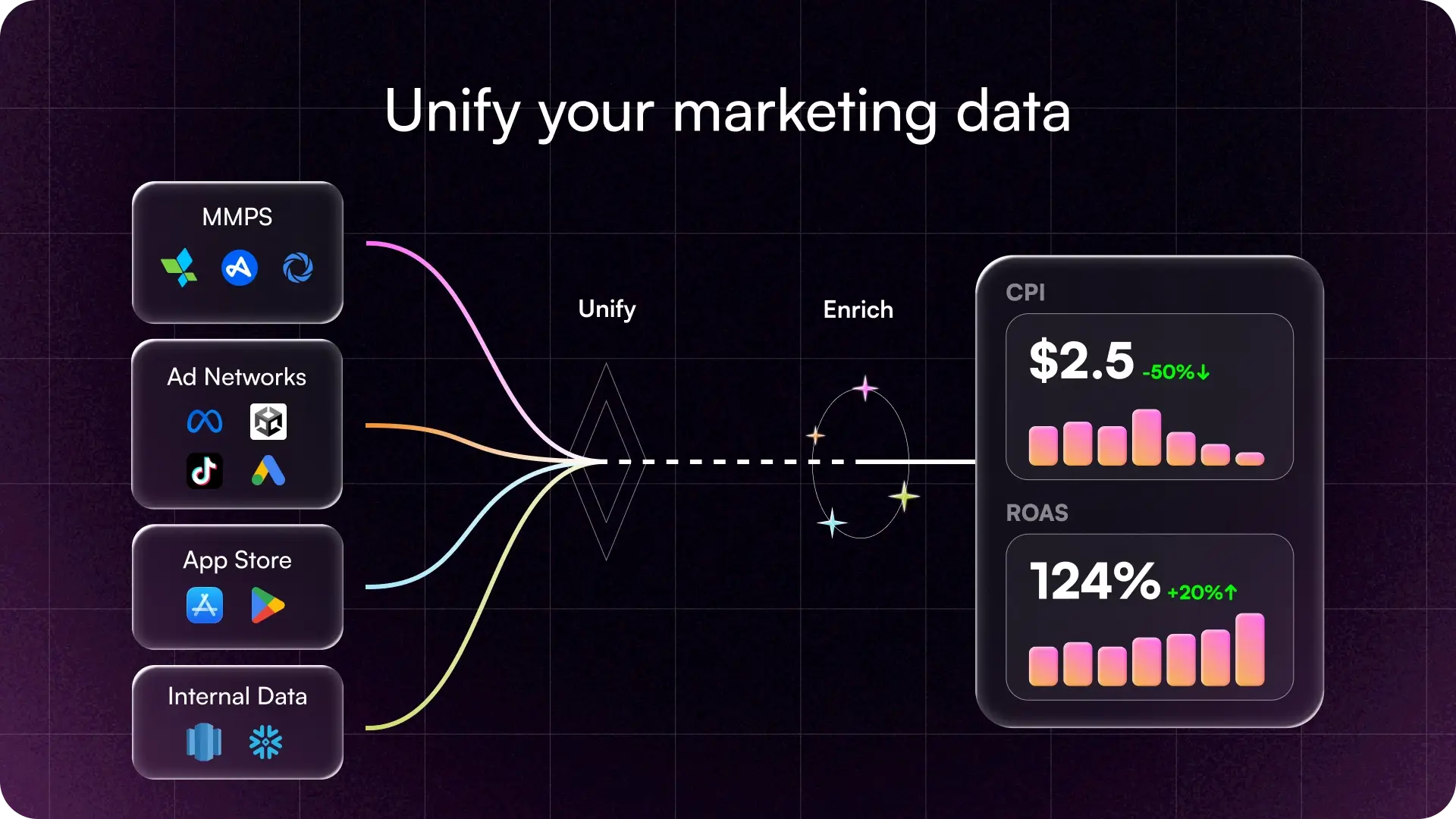
Your performance data lives in at least four places:
- MMPs: post-install attribution from tools (like AppsFlyer, Adjust, or Singular)
- Ad network dashboards: operational tuning, but never a complete source of truth
- App stores: store-page conversion data your MMP can’t see
- Internal sources: BI warehouses, game data, and custom internal logic
The foundation is data: ingest every source, unify and enrich it into one dataset your team can trust. On top of that sit three functions: forecasting cohort revenue, rebuilding the attribution that privacy frameworks remove, and translating payback windows into daily cohort targets.
Use Marketing Dashboards with Granularity
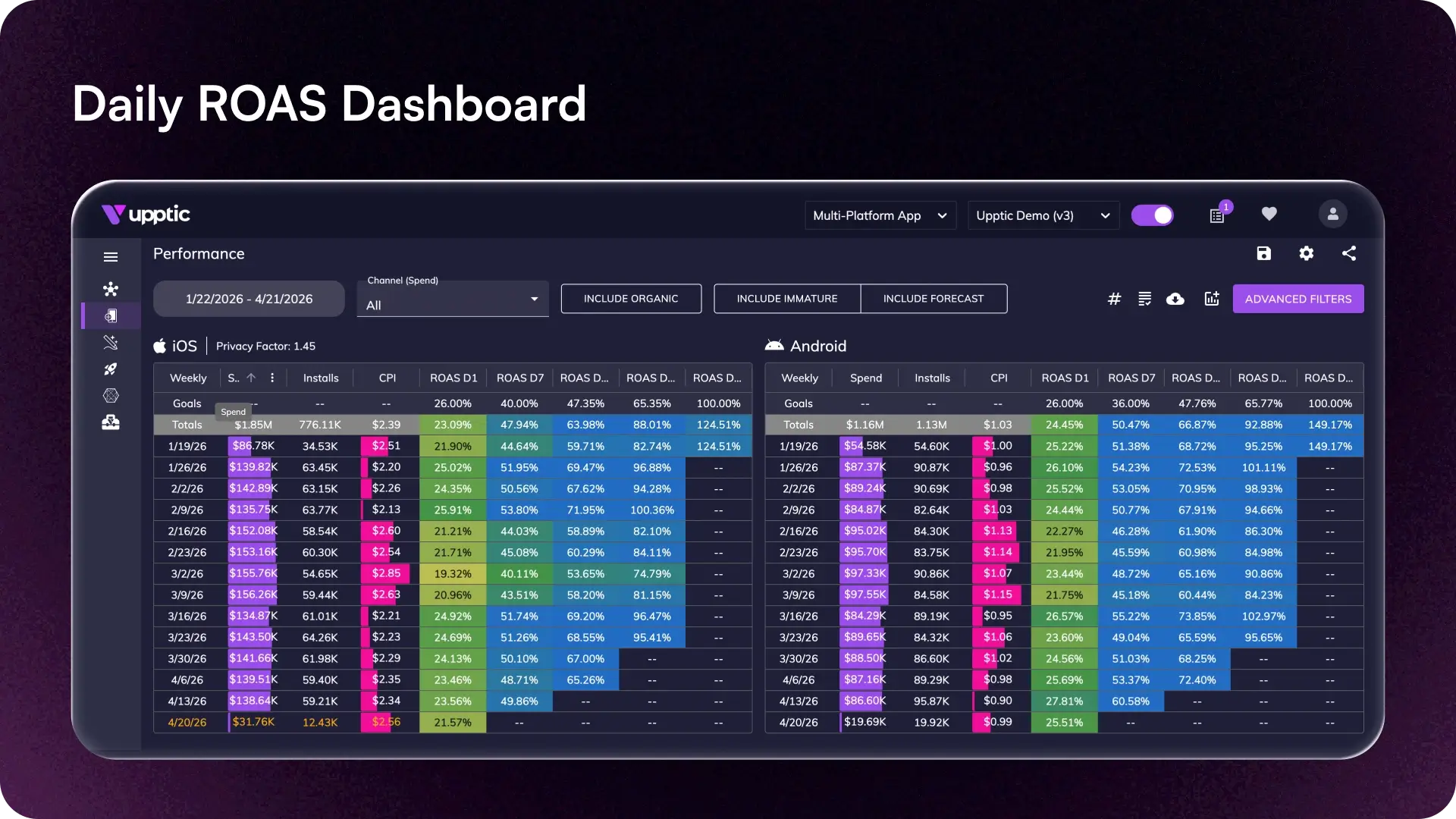
CFOs want deliverable revenue and payback projections. UA managers live in daily cohort performance, channel comparison, and ad-level creative data. Creative teams need concept-level performance. If your marketing director can’t see channel-level ROAS in a format they trust, your entire UA program is a gamble.
Use Predictive Analytics to Forecast with Incomplete Data
Cohort revenue matures over weeks. Apple’s SKAdNetwork aggregates data across users to protect privacy, leaving no device-level attribution on iOS. You’re working with incomplete signal. To close the gap, you need a privacy model that combines SKAN and opted-in MMP data into one view. Then ARPU-curve forecasting can project cohort performance up to 360 days, so your team can make buying decisions sooner.
Do not ignore organic uplift: paid campaigns can drive App Store searches, referrals, and brand discovery that your MMP labels as organic. Without modeling that lift, you may undercount the channels that are actually working.
Validate Buying Targets and Track Ad Spend
Setting buying targets only works if the numbers behind them are reliable. Pressure-test the inputs before you scale including: MMP setup, SDK events, attribution logic, revenue tracking, and cohort reporting.
Watch out for fraud signals like flat retention or monetization curves that look too clean to be real.
Track your spend in real time and keep a live forecast, so the team can spot budget risks early.
Should You Build or Buy Your Marketing Analytics?
You can build this framework in-house, but it takes serious engineering, data science, and UA operations to get right. Most studios are better served buying the infrastructure and focusing their team on building a better game. Platforms like the Upptic Game Growth Engine handle the data plumbing, forecasting, privacy modeling, and reporting needed to run profitable UA.
Running and Optimizing Mobile UA Campaigns
Strategy sets the target. Analytics shows whether you’re hitting them. Operations is how you actually get there. These are the day-to-day UA levers: managing bids and budgets, rotating creative, and deciding which channels to lean into or cut.
Most teams under-invest in ops. The teams running top-grossing mobile game titles invest in it daily, and that’s why they hit their targets.
Two principles shape great UA operations:
- Match channels to your genre, budget, and goals. A hyper-casual title and a 4X strategy game need completely different channel mixes. A mix that works for one will bleed budget on the other.
- Test networks individually. Define the budget, timeline, and success criteria before you launch. A common mistake in UA operations is pausing too soon: teams pull the plug before a channel has the spend, time, or creative it needs to prove itself.
Where Should You Spend Your UA Budget?
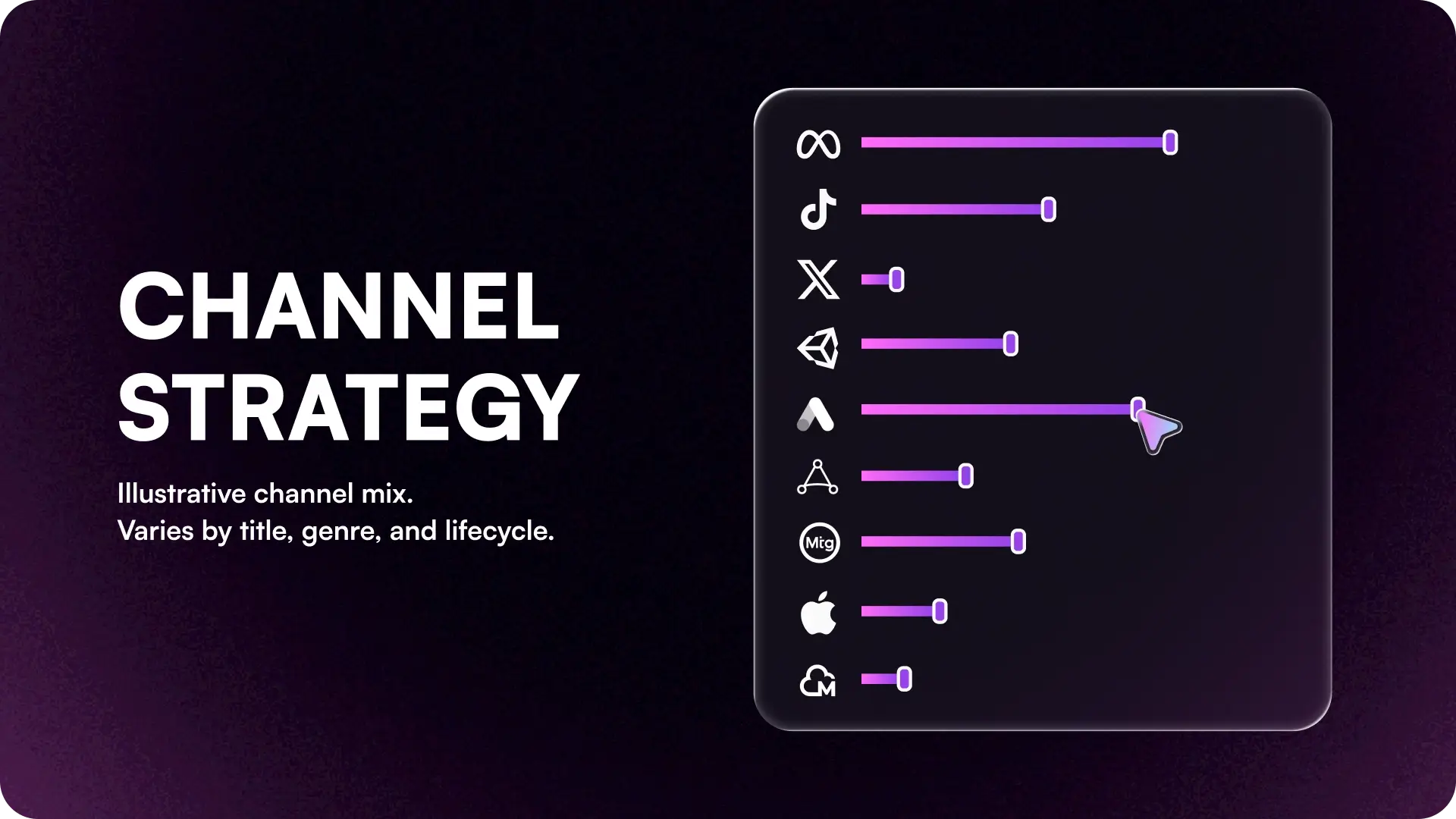
Channel mix shifts by genre, budget, and lifecycle stage, but paid inventory falls into five categories:
- Social (Meta, TikTok, Snap). The largest reach in mobile UA, and the best creative-testing infrastructure. Meta is the default starting point for nearly every game. TikTok is now a real performance channel for mobile games. It rewards volume and variety in short-form video creative.
- Google Ads. Broad reach across Search, YouTube, and the Google Display Network. A strong complement to Meta for most games.
- Rewarded Video / SDK ad networks (Unity Ads, AppLovin, Mintegral). In-app inventory at scale, strongest for hyper-casual and hybrid-casual mobile games.
- DSPs (Moloco, LiftOff, Vungle). Broader inventory across the open web and programmatic exchanges. More operational complexity, but unlocks additional scale after core channels are saturated. Learn more about DSPs in our Programmatic Advertising & DSP Guide
- App Store Search (Google Play, Apple Search Ads). High-intent users at the point of decision. Usually the most efficient channel by ROAS, though limited by how many people are searching for your game by name. Be careful, it’s easy to cannibalize organic users!
Start with proven, high-liquidity networks. Expand only as you validate performance. Scale what works, not what you hope will.
Mobile Game Ad Creative
Creative is where UA is won or lost. The ideal ARPU curve, perfect payback discipline, and optimal channel mix mean nothing if the ad doesn’t convert.
It’s also the pillar where your team has the most freedom. That freedom comes with risk. Creative can flop for reasons no dashboard catches. Sometimes the vibe is just off. Produce for upside, but plan for flops.
What Makes a Mobile Game Ad Convert?
A high-performing mobile game ad does three things well. Sounds simple, right? Almost no one does all three consistently.
- Hook. The first 2 to 3 seconds have to stop the scroll. Not a gimmick. A moment that implies the loop, the payoff, or the tension the game delivers.
- Loop. Show the core gameplay. Players are deciding whether this is a game they want to play, and real gameplay answers that better than any voiceover.
- CTA. End with a clear, specific ask: “Play Now,” “Download Free,” or a gameplay moment that invites the tap.
Creative also has to match the game. A cozy puzzle ad that leads with chaotic combat brings in low-quality installs that churn on day one. A casual puzzle game and a mid-core strategy game are selling different feelings, and the creative should reflect that.
Drive toward the business goal, not just the install. Clickbait and false advertising juice installs but destroy retention and LTV. You’ll see it in your cohort curves two weeks after launch, and by then the damage is already done.
Creative Testing: How to Find Your Winners
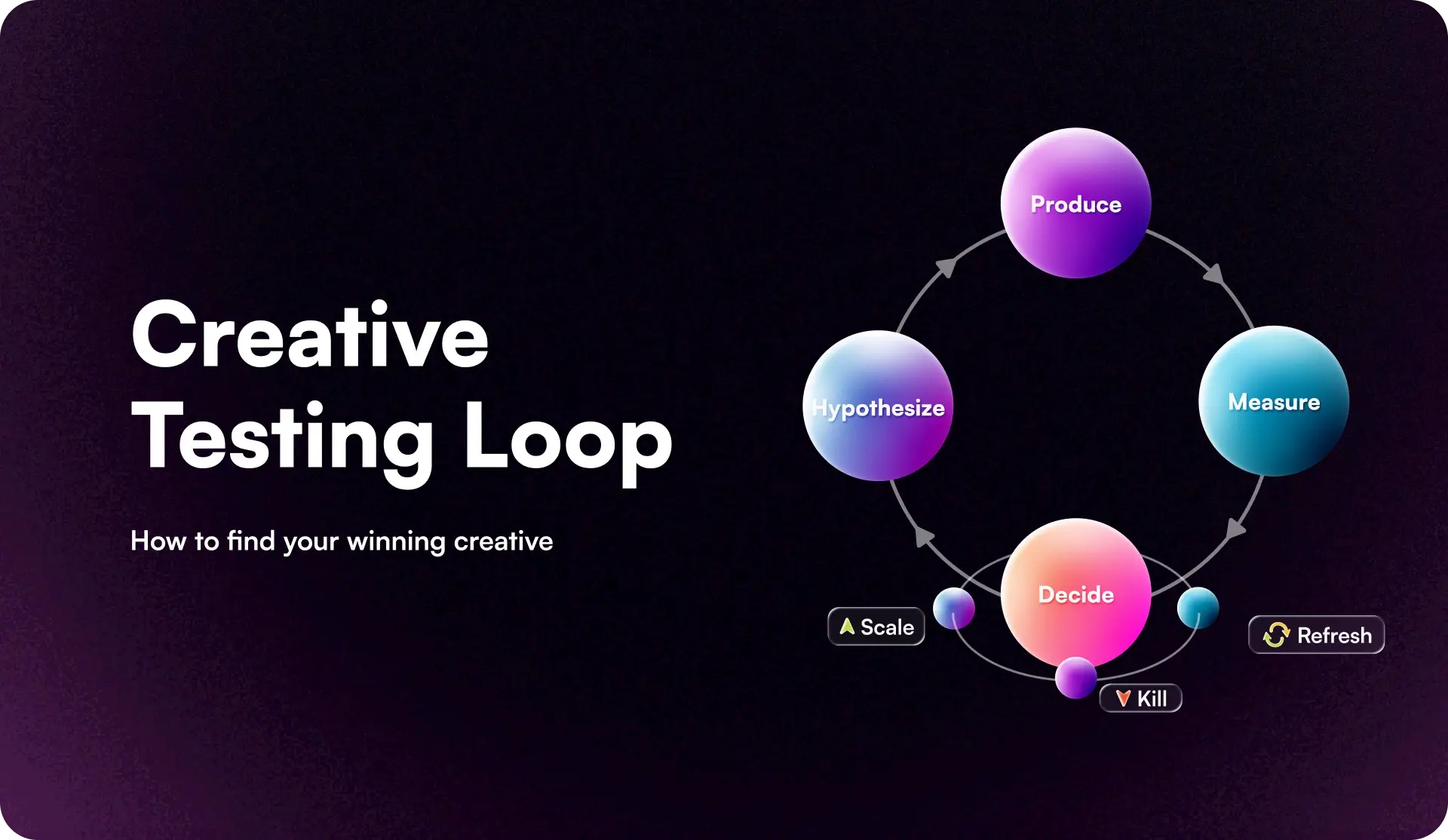
Structured testing means iterating on isolated variables so you know what’s actually working.
A real pipeline answers four questions for every test.
- What are we testing? The hook, the gameplay, the music, the UGC host. Test one or two variables at a time, never more.
- How will we measure it? IPM (installs per 1,000 impressions) or ROAS at a defined day, with a minimum impression threshold before you call a result.
- What do we do with the results? Winners get variants. Losers get killed or reworked with a new hypothesis.
- When do we kill, refresh, or scale? Set kill criteria, scale criteria, and refresh cadence before the test goes live.
Creative Fatigue: When to Kill an Ad
Even winning creative decays. Creative fatigue, also called ad fatigue, is the gradual erosion of performance as an audience sees the same ad too many times. You’ll see it as rising CPI, falling CTR, or dropping IPM on a creative that used to print.
Refresh when fatigue becomes measurable. Otherwise, let winners ride. If you rotate creatives on a rigid schedule, you’ll kill winners too early. Skip rotation entirely and you’ll pour spend into ads that died weeks ago.
Which Ad Formats Work Best for Mobile Games?
Creative ad formats and styles are another variable worth testing. Here’s what dominate mobile game UA:
- Video. Still the workhorse across social and in-app networks. 15- and 30-second cuts are the standard. Vertical 9:16 is the default, with square and horizontal resizes for specific platforms.
- Playable. Interactive mini-versions of the game, rendered in HTML5. Strongest in hyper-casual and hybrid-casual. Increasingly converts better than comparable video for teams willing to invest in production.
Which ad trends & styles are currently working?
- UGC Style. Real or realistic-looking people reacting to, reviewing, or playing the game. Outperforms polished studio work in most social placements.
- Native. Blends into the feed or in-app environment. Lower friction, but the creative has to feel native to the platform, not like an ad wearing the platform’s clothes. The aesthetic can shift every few months.
- Low-fi gameplay. Rough screen recordings, authentic moments, minimal post-production. Reads as authentic in an environment flooded with overproduced ads.
- Honest gameplay. The industry has cycled back toward ads that represent the actual loop. Misleading “fake gameplay” ads still work short-term in some genres, but the retention and LTV penalty has gotten harder to ignore.
Trends move fast. Test what’s working this quarter.
App Store Optimization (ASO): Where Taps Become Installs
Your store page is where ad spend becomes installs. Store page conversion amplifies your UA funnel. You could drop your effective CPI by a third just by fixing your store page. ASO is a major unlock for UA leverage.

The core ASO elements to optimize:
- Metadata. Title, subtitle, keyword field, descriptions. Be descriptive, not clever. Search and AI-based discovery both reward entity-rich, specific language.
- Visual assets. Icon, screenshots, preview video. Treat these like ad creative. Test variations, measure impact, iterate.
- Custom Product Pages (iOS) and Store Listing Experiments (Android). Match the store page to the ad. High-leverage and underused.
Benchmarks vary widely by genre. A page that converts well for a casual puzzle game rarely works for a 4X strategy title. If you want an audit on where your store page stands in your genre, reach out to our team for a direct benchmark.
Mobile Game UA Checklist
UA teams that are scaling profitably check every box. Can you?
- Define your UA goal and lifecycle stage. Soft launch, scaling, or evergreen. Each has a different strategy.
- Set your buying targets and payback window. Your ARPU curve and business model drive the numbers.
- Lock in your marketing intelligence layer. MMP, iOS privacy modeling, and cohort reporting that reconciles across sources.
- Turn numbers into decisions. Forecasts you can audit and spend you can see in real time.
- Build a channel testing plan. Test channels one at a time, with budget and kill criteria set before launch
- Run a creative testing pipeline. Hypothesize, measure, iterate, and kill/scale criteria solidified before tests go live.
- Fix your store page before scaling spend. Conversion rate multiplies every dollar downstream.
Want to plug into a proven UA system with a team that runs it for you? Talk to us.