
Paid vs. Organic UA is the Wrong Debate: Build a Combined Strategy
The debate between paid vs. organic user acquisition creates a civil war in your marketing operation. It forces a false binary where teams fight for credit, leading to siloed and unaligned optimization.
The stakes are high. Rely purely on “Blended” metrics, and you risk fatal errors – like using organic revenue to hide inefficient ad spend. View them in isolation, and you miss the compounding reality: Paid fuels the Organic fire.
That surge in paid activity drives App Store searches, word-of-mouth, and chart visibility. Your dashboard calls those users “organic.” In reality, you paid for them.
You don’t need a winner between the two. You need a strategy where paid UA is independently profitable, yet explicitly deployed to accelerate your long-term organic equity.
Here is how we build that system.
Product Monetization: The Blueprint for Paid vs. Organic User Acquisition
Before you set a budget or hire an agency, look at your product metrics. Your product’s monetization determines your mix, not your CFO.
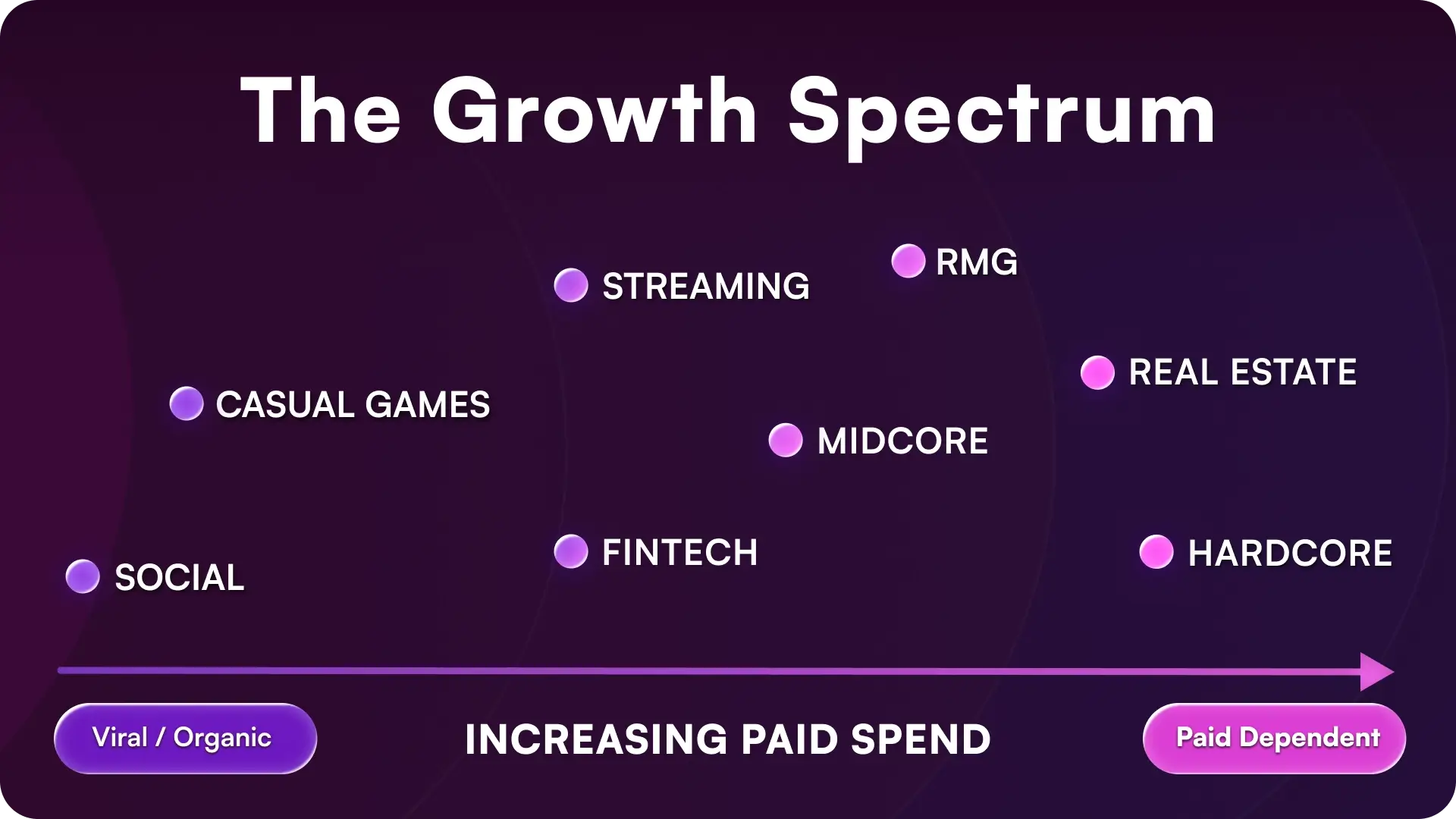
After launching 60+ games and apps and managing $200M+ in ad spend, we’ve seen that most studios fail by treating paid and organic as separate silos. At Upptic, we manage them as a unified growth system. To build that system effectively, you first have to understand which of these three monetization buckets your product falls into:
- Organic-Led (High K-Factor/Viral): Think Wordle, Among Us, or Minecraft. Growth is driven by user referrals. Paid UA here is supplementary, often used later in a lifecycle to prop up volume.
- Paid-Led (High Intent/Low Viral): Think Social Casino, 4X Strategy, or high LTV Fintech apps. These products don’t typically “go viral.” They rely on buying high-value users. Effective paid marketing is the engine.
- Hybrid (The Standard): This is the reality for most modern studios. You have some natural organic visibility (ASO, word of mouth), but you need paid velocity to scale.
The Role of Paid vs. Organic
Clients often ask us, “When should I focus on paid vs. organic??”
The answer: there is no universal benchmark; it is an outcome of your product’s DNA, your market position, and your company’s risk posture and lifecycle.
Organic-Dominant Mix: Almost all brands would prefer an organic dominant mix. It signals high virality or brand equity. You also get the massive benefit of near zero marginal CAC (cost of acquisition). Being in a position where your business is driven primarily by organics has massive advantages but the downside is a lack of control. You cannot simply “spend more” to hit a revenue target if the viral loop slows down.
Paid-Dominant Mix: A paid dominant mix is enabled by a sophisticated and well funded user acquisition operation. It demonstrates a sustainable balance between CPI and LTV which enables a product to buy growth. The benefit is immediate, predictable scale. The downside is exposure to market volatility. If CPMs spike, your margins compress which can lead to negative profitability or stalled growth.
The Bottom Line: Use Paid to drive velocity where your unit economics allow, and use Organic to build durability.
Organic Uplift / Incrementality
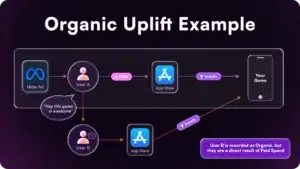 Your paid campaigns drive more installs than your MMP is able to track. These unattributed organic installs generated by paid marketing are called organic uplift. Cautious benchmarks put this at roughly 5:1 (one organic install per five paid), though at scale with strong viral product hooks, that ratio can exceed 1:1. The exact volume depends on your product, tracking infrastructure, and marketing mix.
To fully understand the impact of organic uplift on your paid marketing activities, read our full guide: Measuring Organic Uplift and Incrementality →
Important Considerations for Paid vs. Organic User Acquisition
1. Paid Channel Profitability (The Rule for Sustainable Growth)
As a general rule, paid channels must be incremental and profitable on their own (once accounting for organic uplift).
This is the single most important discipline in performance marketing, and the one most frequently broken.
The Blended ROAS Blind Spot
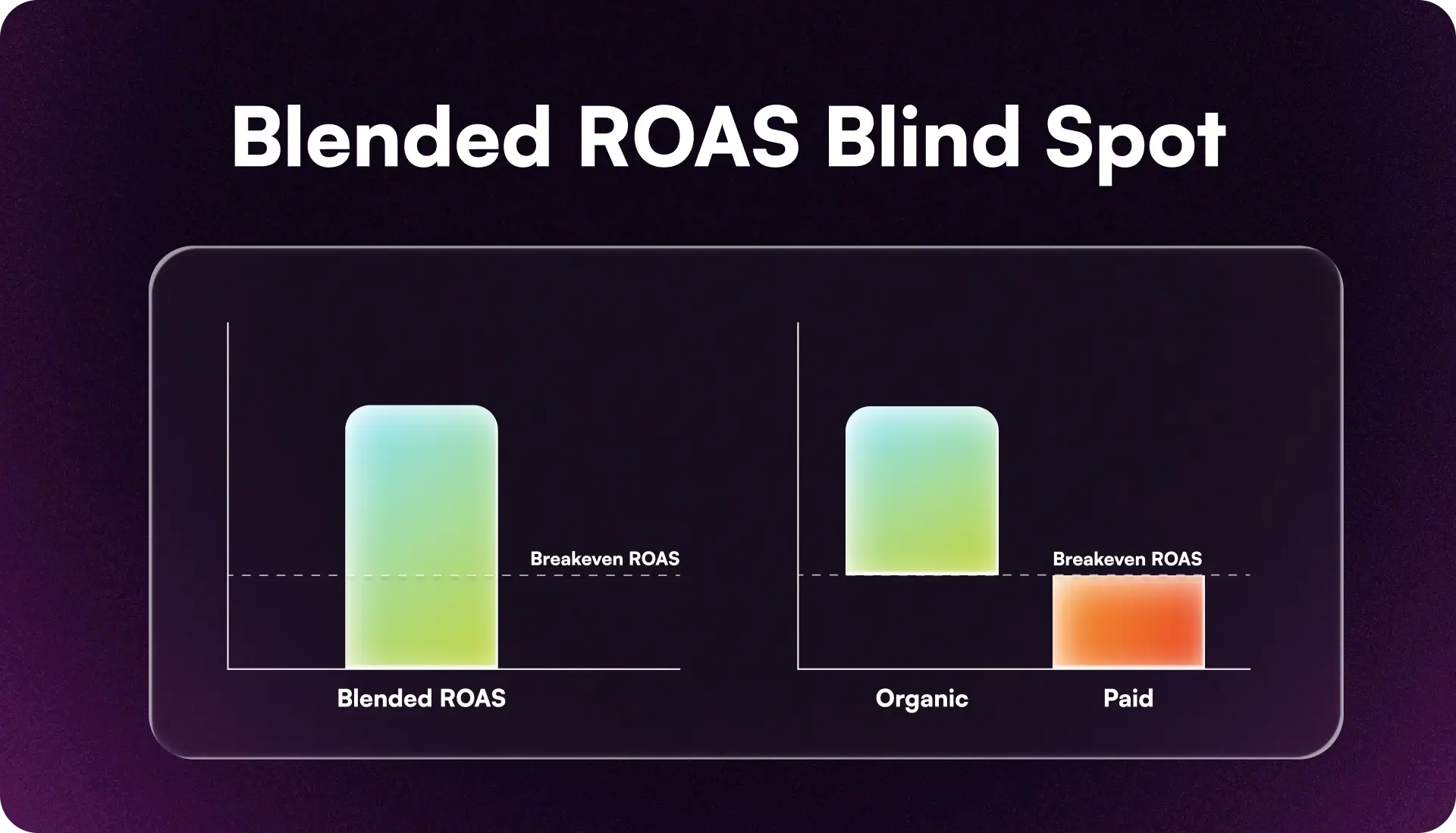
When teams combine paid and organic into a single blended ROAS, unprofitable paid channels can hide behind high-margin organic revenue. The dashboard looks fine, but you’re using organic to justify bad ad buying, and that won’t last forever.
It happens because organic revenue feels “free,” so teams assume it can absorb paid-side inefficiency. Meanwhile, revenue from older cohorts keeps rolling in regardless of what you spend today, so the damage stays invisible until it isn’t.
This blind spot gets even more dangerous when you start optimizing around blended metrics, which is exactly how teams fall into the Tailwind Trap.
The Fix: Channel-Level Accountability
Every paid channel should be evaluated on its own merits against a target ROAS derived from your LTV curves, not in aggregate. If a channel misses its target, optimize it or cut it. Never justify underperformance because “organic is free, so it evens out.” That is how you drain a studio’s bank account.
2. Blended ROAS/CAC & The Tailwind Trap
Metrics like Blended CAC and Aggregated ROAS are useful for board meetings, but dangerous for optimization. This is the Blended ROAS Blind Spot in action, taken to its extreme.
The danger lies in confusing Recognized Revenue (cash hitting the bank today) with Cohort Revenue (future value of new users).
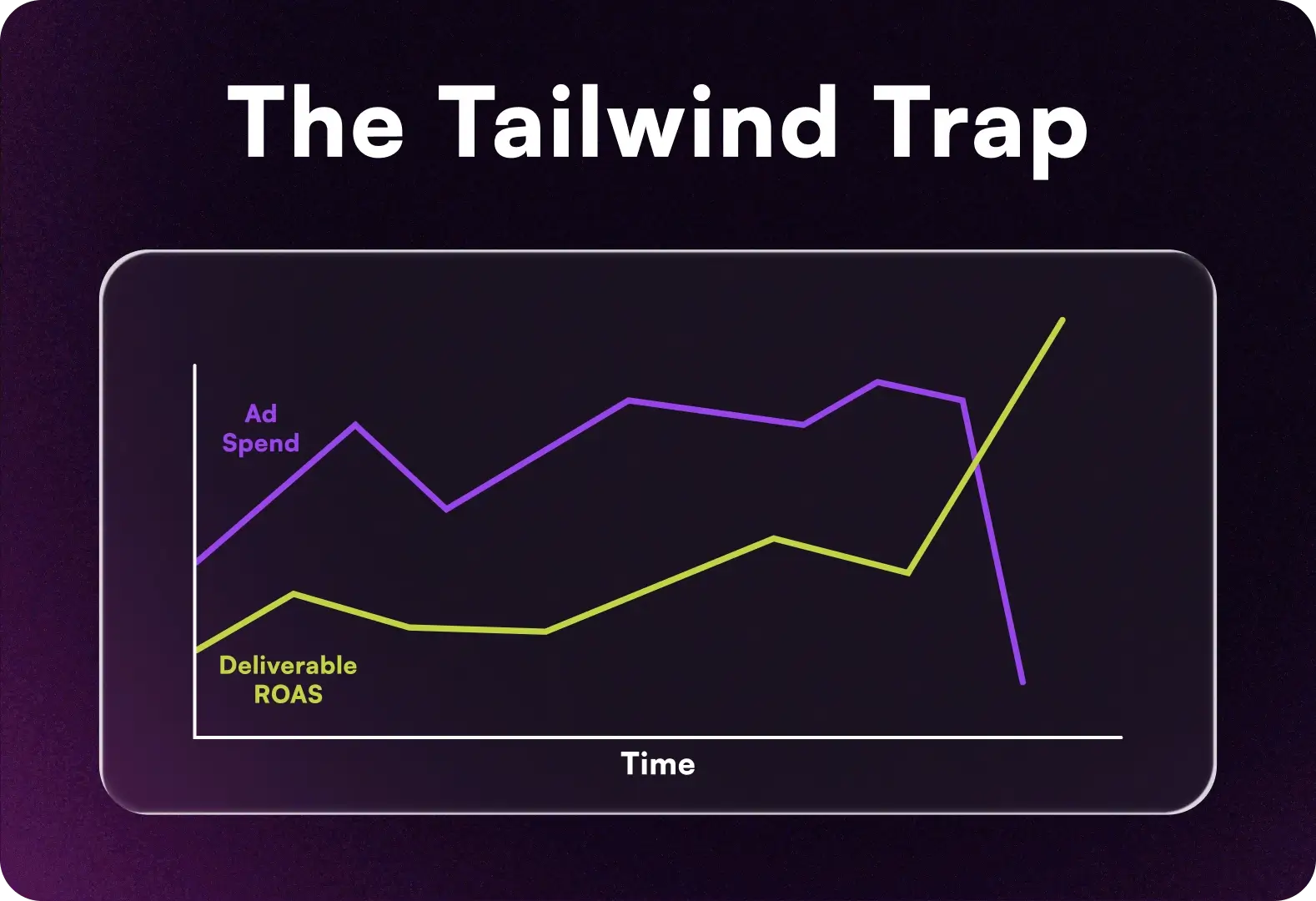
If you optimize solely for Blended ROAS, you fall into the Tailwind Trap. Cut ad spend to zero and your Blended ROAS looks amazing temporarily: you’re cutting costs while still collecting revenue from past cohorts. But you’ve stopped generating new Cohort Revenue. Once that “tail” of old users fades, your growth crashes.
3. Cannibalization Check
Are you paying for users you would have gotten anyway?
One example of cannibalization is bidding heavily on your own brand terms which can artificially inflate paid performance. If you have the top organic spot for your game’s name, buying the banner above it might be a defensive strategy, or it might be a waste.
The Fix: Data is the only way to distinguish defense from waste. Use tactics like incrementality testing and Media Mix Modeling (MMM) to isolate the true lift of branded campaigns.
Learn more about how to about incrementality: Measuring Organic Uplift and Incrementality
4. Critical Mass & Reinforcement
In many genres (especially multiplayer), the game doesn’t work without people. High-volume paid acquisition drives the incremental user base needed to activate organic loops.
- Matchmaking Liquidity: In multiplayer titles, low liquidity kills retention. Paid UA fills the queues, reducing wait times and ensuring players are matched by skill level rather than just availability.
- Competitive Density: Empty leaderboards don’t drive revenue. A dense population creates social pressure and makes the ecosystem feel “alive,” which increases monetization rates for organic players.
- App Store Signals: High velocity of paid installs signals popularity to the stores, often triggering “Trending” or “Top Chart” placement. This generates free organic installs.
Immediate Scale & Consistent Growth: The Combined Strategy
Once you understand the metrics, how do you execute?
Think of it this way: Paid Media delivers immediate scale (fast, leveraged, precise). Organic provides slow & consistent growth (cumulative, durable).
The winning strategy uses paid scale to drive profit and as a testing lab for your organic growth tactics.
The User Acquisition to App Store Optimization Pipeline
Most teams guess what screenshots, gameplay trailers, and app icon will work on the App Store. This is where most UA teams miss the opportunity. Paid acquisition is not just a distribution engine, it’s the fastest creative testing environment available.
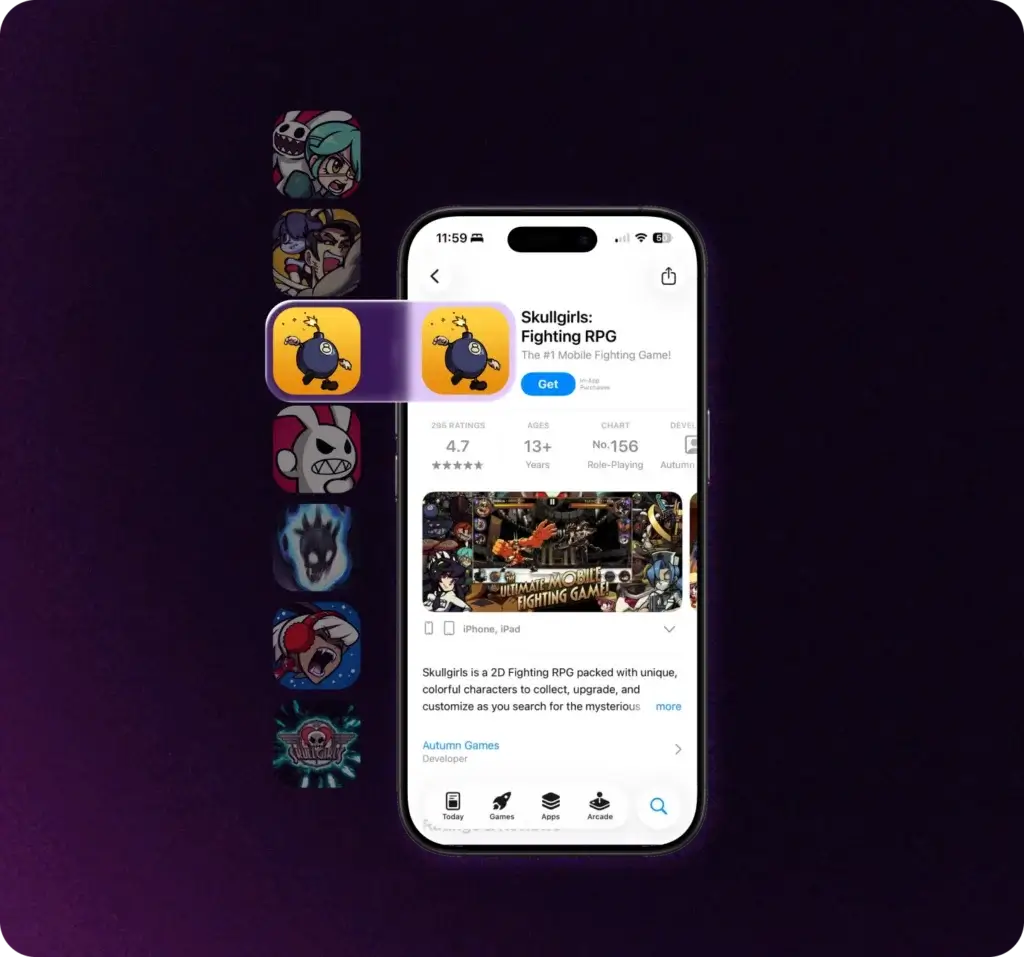 At Upptic, we don’t guess. We test using our thorough App Store Optimization (ASO) Framework. We run structured creative testing across paid channels to identify concepts with strong CTR and IPM signals. Those winning concepts are then deployed into Custom Product Pages and Custom Store Listings and eventually the default store page to permanently lift organic conversion.
- Test: Run aggressive creative tests on paid channels to identify clear winners (high CTR/IPM).
- Match (CPPs & CSLs): Don’t send that specific traffic to a generic store page. Use Custom Product Pages (CPPs) and Custom Store Listings (CSLs) to align the App Store imagery with the winning ad creative. If users click an ad for a specific feature, they should land on a page highlighting that feature.
- Promote: Once a concept proves it appeals to a broad audience, promote those assets to your default App Store screenshots to lift organic conversion.
This permanently lifts your organic conversion rates for all traffic, not just paid users. This is the definition of a combined strategy.
TL;DR & Strategic Checklist
Paid vs. Organic is a distraction. The real goal is a unified growth engine where every dollar spent makes your free traffic work harder. Here’s how to build it:
Your Action Plan:
- Start with your Product DNA. Viral, Paid-Led, or Hybrid? This determines your paid/organic mix.
- Then enforce Channel-Level Profitability. Every paid channel must hit its own ROAS target. Don’t let blended metrics hide bad spend. The Blind Spot leads straight to the Tailwind Trap.
- Measure what your dashboard misses. Paid spend drives organic installs your MMP can’t track. Conservatively one organic install per five paid, and potentially 1:1+ at scale. Use incrementality testing to see the full picture, including whether you’re cannibalizing traffic you’d get for free.
- Then compound it. Test creative on paid channels, deploy winners to Custom Product Pages, and promote to your default storefront. This permanently lifts organic conversion. That’s the combined strategy working.
Ready to stop guessing and start scaling? Building a model that accurately measures the interplay between paid and organic is difficult, but it’s what we do every day.