
How to Use DSPs Without Burning Cash
Most growth teams treat Demand Side Platforms (DSPs) as a magic bullet. They assume once they max out Meta and Google, they can simply plug in a DSP and watch incremental installs roll in.
Here’s the thing: DSPs are not “set it and forget it” machines. They are powerful tools for your UA portfolio, but without a clear strategy, they introduce structural inefficiencies that drain your budget.
Unlike direct channels where you pay the network that owns the inventory (like Unity or AppLovin), DSPs act as aggregators. This adds layers: tech fees, exchange fees, and reseller margins. But the “Middleman Tax” isn’t the whole story. DSPs often possess unique data signals and learning algorithms that allow them to find high-value users within the same inventory that your direct buying may fail to crack.
The goal isn’t to avoid DSPs. It’s to manage them so the incremental scale outweighs the added cost. Here’s how to execute a programmatic strategy that actually works.
The Ecosystem: What is Programmatic Advertising?
Before we get into strategy, let’s clear up the mechanics.
- Programmatic Advertising: Automated buying and selling of online advertising space. Instead of calling a publisher to book a banner ad, software does it in milliseconds.
- DSP (Demand Side Platform): Software you use to buy ads. It’s the bidder.
- SSP (Supply Side Platform): Software publishers use to sell their inventory.
- RTB (Real Time Bidding): An instant auction where the transaction happens.
The bottom line: When you use a DSP, you are hiring a robot to go to the auction for you. Your success depends entirely on how well the algorithm is trained, and how you feed it targeting parameters.
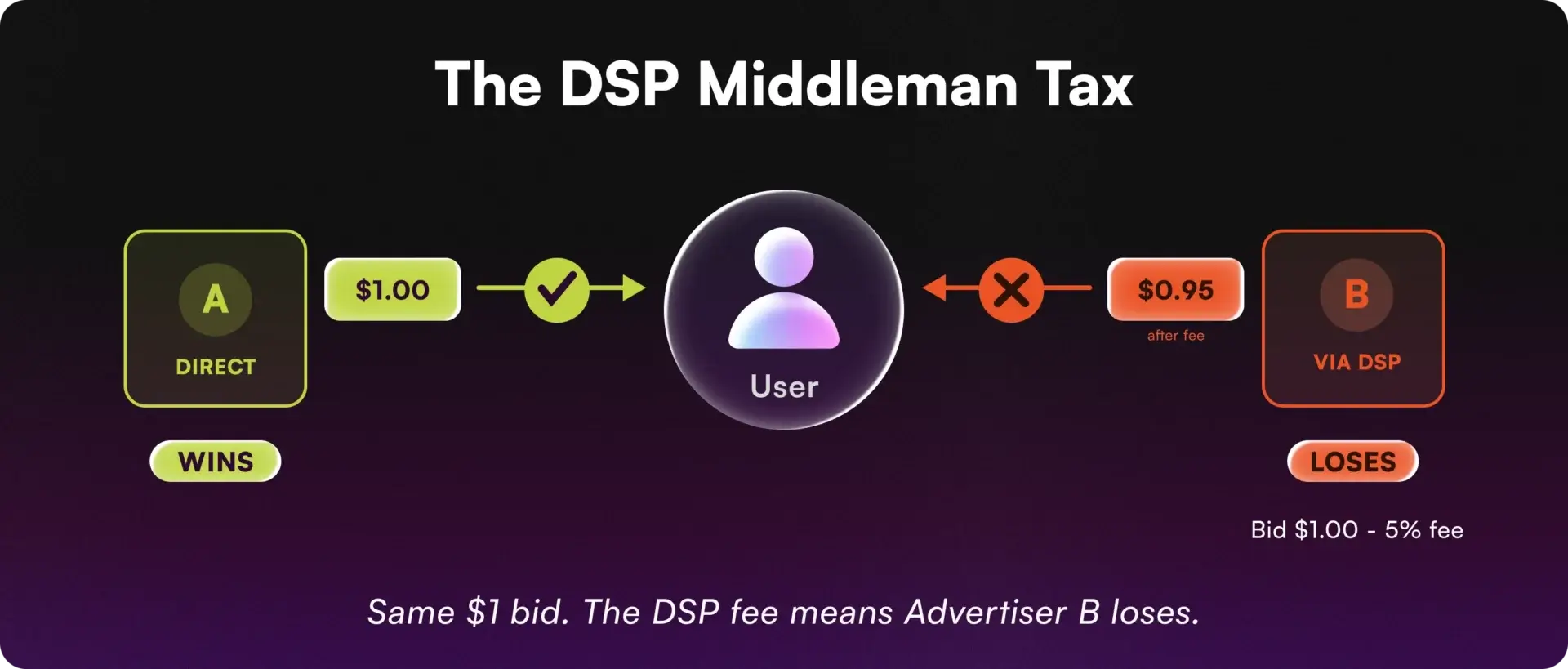
When you buy directly from a network (like Unity), your whole dollar goes into the bid. When you buy through a DSP, you pay tech fees and exchange fees before your bid even hits the auction.
The Math: If you and a competitor both bid $1.00, the direct buyer wins. The DSP buyer effectively bids $0.95 after fees and loses.
The Lesson: You cannot win on a DSP by simply “buying the same thing.” To overcome the tax shown in Visual 1, your DSP must be smarter, finding users the direct networks missed.
Direct vs. DSP: The “Cannibalization” Trap
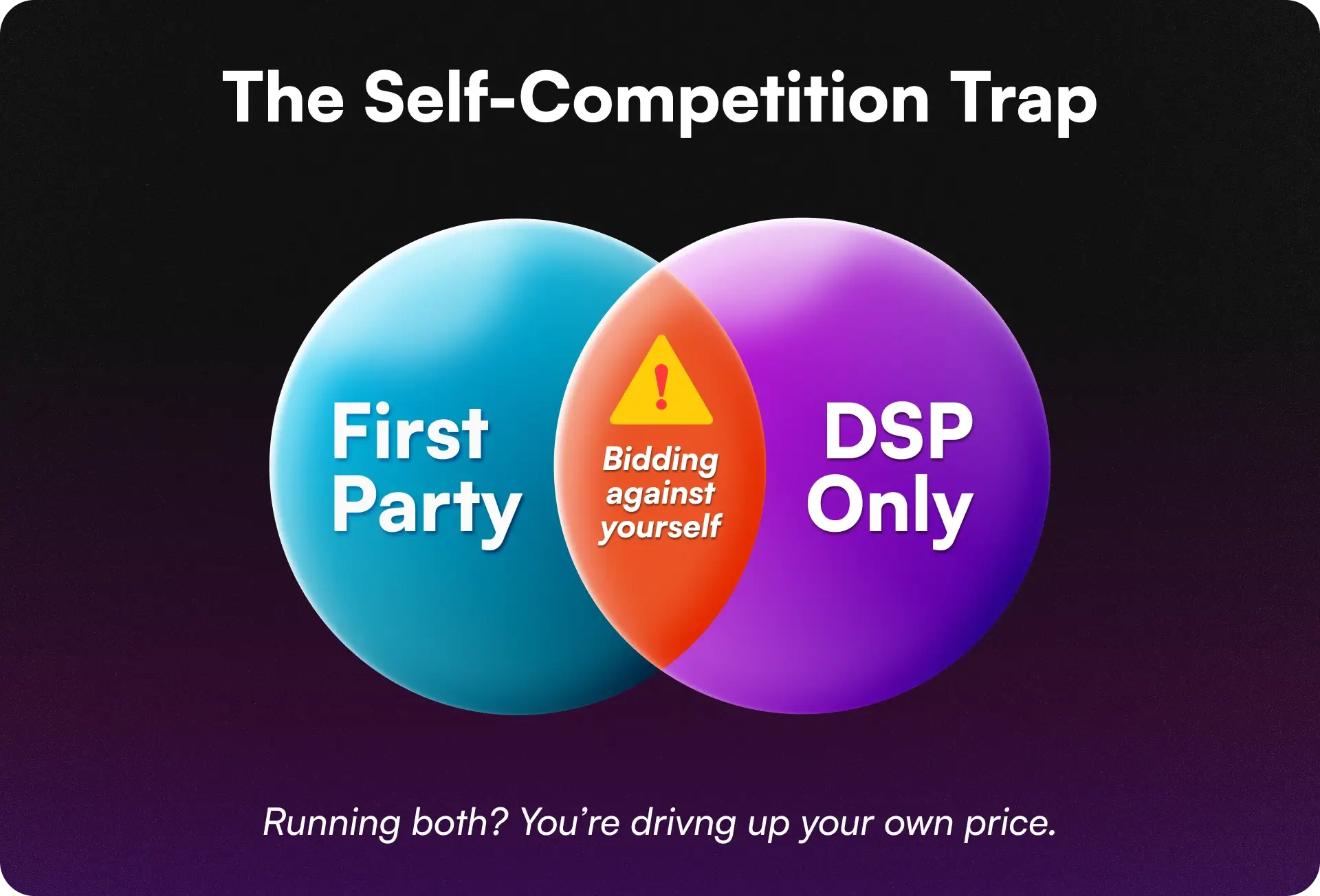
Since DSPs plug into the same exchanges you likely buy directly (Google, Unity, AppLovin), there is a structural overlap.
- The Red Zone (Waste): As the graphic shows, if your DSP bids on the exact same user you are already targeting directly, you are just driving up your own price. This is pure waste.
- The Orange Zone (Incrementality): The goal is to push your DSP into the “DSP Only” circle, finding users your direct campaigns are ignoring.
How to avoid the Waste: While the risk is real, it isn’t inevitable. Networks are massive. If your direct campaign is fishing in one pond, a DSP’s unique algorithm can fish in another, even within the same exchange.
The Fix: Monitor blended performance. If adding a DSP increases total volume and maintains stable ROAS, you are successfully expanding the “Orange Zone” rather than just widening the “Red Zone.”
The “Lazy” Algorithm Problem
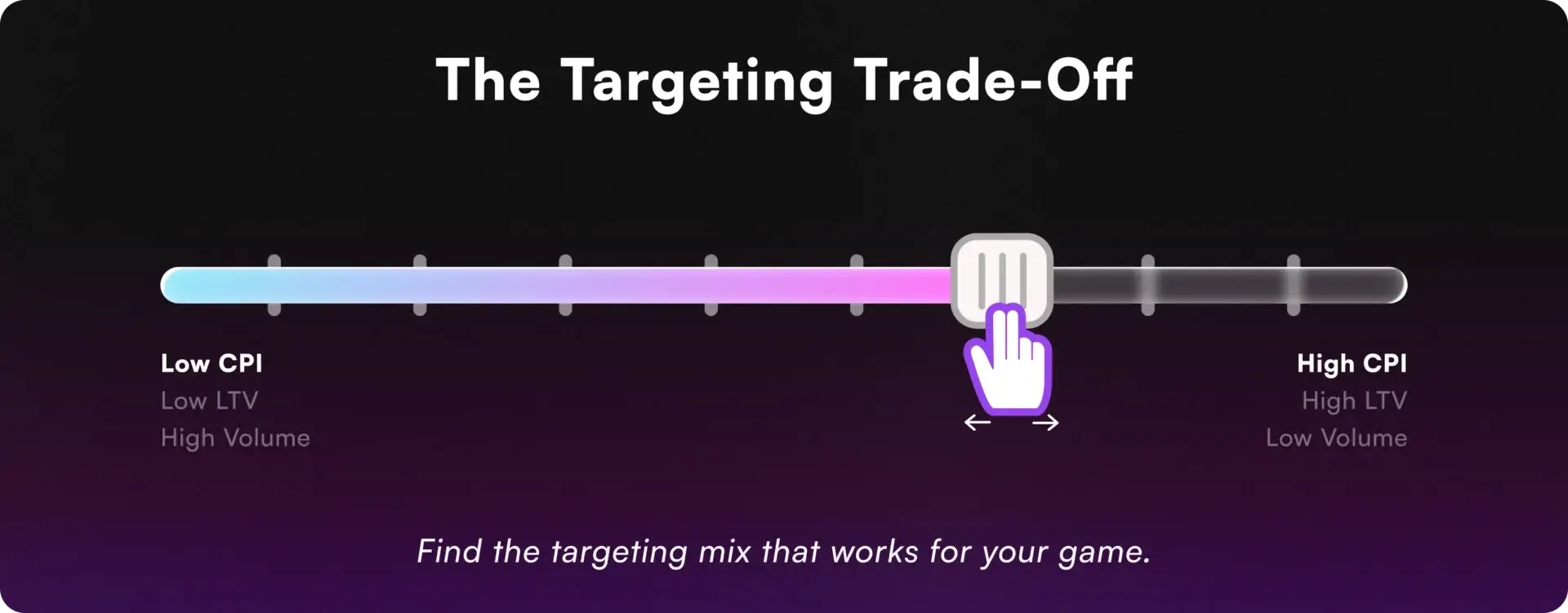
The DSP algorithm isn’t necessarily “lazy.” It is obedient. It will ruthlessly optimize for the specific target you give it (CPI, CPA, or ROAS).
- The Left Side (Low CPI Target): The algorithm hunts for the cheapest users. This drives high volume but potentially “random” user value.
- When to use it: Games with broad appeal that can flourish on cheap users.
- The Right Side (High ROAS/CPA Target): The algorithm filters for high-value behaviors (e.g., “Cost Per First Deposit”). This ensures quality but restricts volume and raises costs.
- When to use it: “Hardcore” or niche games that rely on high-LTV whales to survive.
Align the Target with Your Economics
Don’t just “set it and forget it.” Actively choose the proxy target that fits your game’s business model.
Choose Your Lane: If you have a high-LTV strategy, don’t chase cheap installs. Set a down-funnel target (like ROAS or Deposit CPA) and accept the higher cost.
Watch for “Balancers”: Regardless of your strategy, ask your rep if they use “Balancers” to blend in cheap traffic. You want your target to be met organically, not artificially manipulated.
Force Formats: If you know Video or Playables drive your best LTV, force the DSP to prioritize those formats, even if the CPM is higher.
When to Scale: The Prerequisites for DSP Success
Programmatic advertising is high-risk, high-reward. If you are an early-stage app or working with a limited budget, you are not ready for this.
Only activate a DSP if you meet these three criteria:
- Budget Depth: You need roughly $10k–$50k just for the “Learning Phase.” DSP algorithms are data-hungry. Starve them with a $500/day budget, and they will never gather enough signals to optimize.
- Economic Stability: Your app needs a mature economy. If your LTV curves are shifting, the DSP algorithm cannot calibrate.
- Patience: You must be willing to burn cash upfront. If you pull the plug after two weeks of bad ROAS, you wasted 100% of that money.
Demand Side Platforms by Specialty
The DSP market is deep. Here’s how to think about the landscape by use case.
Scale & ML-Driven Optimization
- Moloco: ML-focused DSP built for finding high-value users at scale.
- Liftoff: Broad mobile reach with strong optimization tooling.
Retargeting & CTV
- Adikteev
- RevX
Cross-Category
- Bidease: Established in non-gaming verticals, now expanding into gaming.
Other Partners Depending on your genre and geo: Appier, Aarki, Mintegral, Kayzen.
The Bottom Line: Your Programmatic Checklist
DSPs are a scaling lever, not a foundation. They belong in your strategy only after you have dominated Social and Direct Ad Networks.
Before you commit budget:
- Audit: Have you truly maxed out your direct channels?
- Pull Levers: Have you set targets that match your game’s economics?
- Set a Goal: Is your business financially ready for a $10k–$50k learning phase?
Want to scale your DSP without burning budget? Let’s audit your traffic mix.