
What percentage of your “organic” installs are actually being driven by paid marketing?
More than you think. A cautious benchmark is one organic install per five paid (20% uplift). At scale with strong product hooks, your organic uplift ratio can exceed 1:1, with paid marketing generating more organic users than it directly acquires.
Understanding the incremental impact of paid marketing on your organic revenue is critical when operating any paid performance marketing at scale.
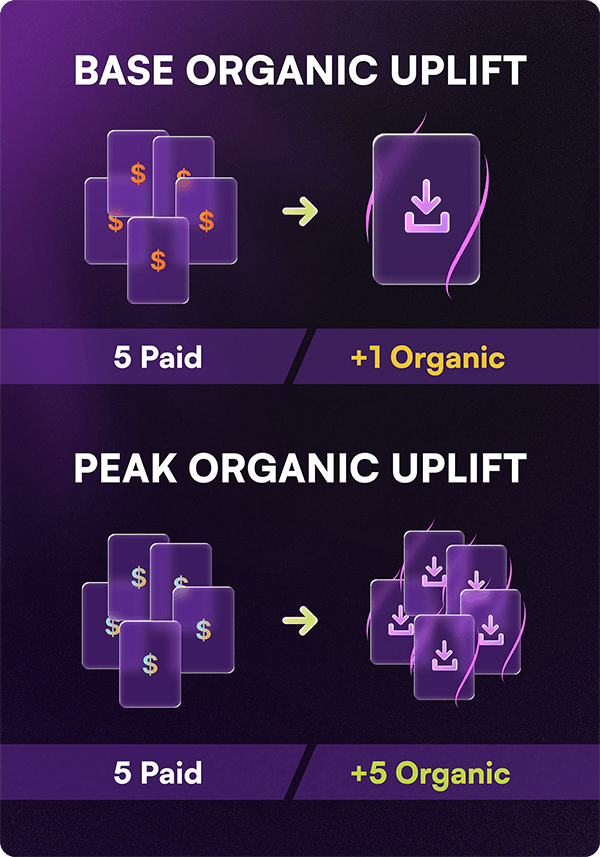
Paid campaigns don’t just generate direct, trackable installs. They create downstream visibility that drives App Store searches, word-of-mouth referrals, and brand discovery that your MMP attributes as organic. This untracked value is called organic uplift, and without a framework to measure it, your attribution data is telling you a warped marketing story.
Measuring and correctly attributing these untracked incremental users requires an intelligent and dynamic measurement framework.
For the strategic framework on how paid and organic work together as a unified system, see our guide: Paid vs. Organic UA: How to Build a Combined Strategy
What is Incrementality?
Incrementality in marketing measures the true causal impact of a marketing activity on a target KPI (installs, revenue, in-app purchases) by isolating one question: “What would have happened if you hadn’t run this campaign?”
A campaign that generated 10,000 installs sounds impressive, but if 7,000 of those users would have found you organically, the incremental number is 3,000. Those 3,000 installs are the actual value your campaign created. Without measuring incrementality, you’re scaling channels that cannibalize organic traffic and cutting ones that quietly drive massive downstream value.
What is Organic Uplift? (Incrementality in Action)
Organic Uplift is the incremental users generated by paid marketing but attributed as organic installs. Your paid campaigns drive visibility, word-of-mouth, and App Store searches that result in installs your MMP can’t trace back to an ad click. Those installs show up as “organic” in your dashboard, but they wouldn’t exist without your paid spend.
Let’s walk through a sample user journey:
- User A sees an ad on Meta, clicks, and installs. (Tracked: Paid)
- User A loves the game and tells User B.
- User B searches the App Store and installs. (Tracked: Organic)
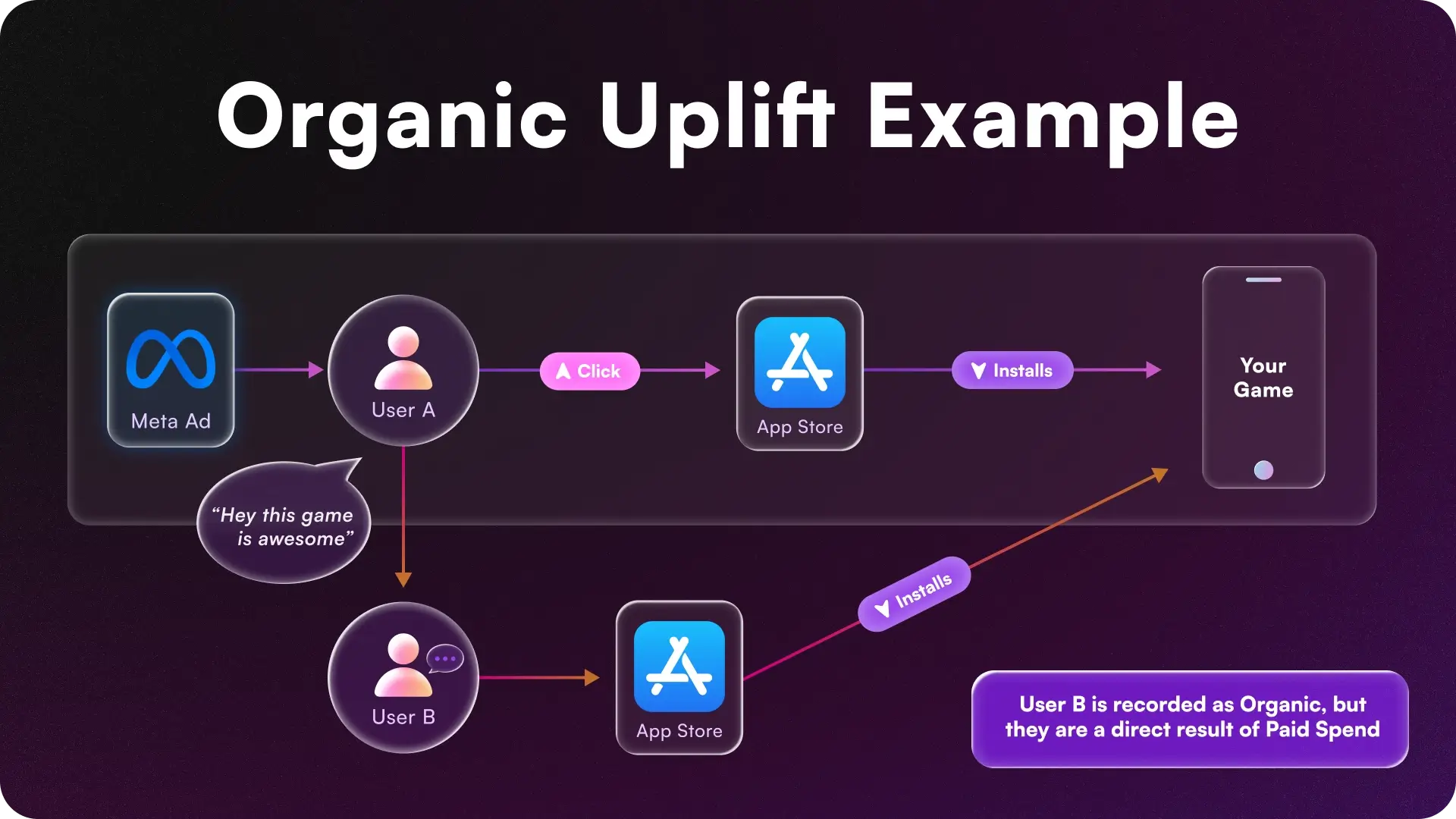
Your measurement system tracks User B as “Organic,” but they are a direct function of paid marketing. If you only measure direct clicks, you are blind to this advertising lift. You might cut a high-performing ad campaign because its direct ROAS looks low, unaware that it could be driving significant unattributed incremental lift — recall that even cautious benchmarks suggest one organic install per five paid.
Capturing this value requires a measurement model that looks beyond the click. We’ll break down that methodology in the How to Measure Incrementality section below.
Organic Uplift vs. Organic Cannibalization
The inverse of organic uplift is organic cannibalization, where paid campaigns claim credit for users who would have installed organically anyway. Both effects happen simultaneously in your campaigns. We go deeper on cannibalization in our guide: Paid vs. Organic UA: How to Build a Combined Strategy
Why Incrementality Matters For Mobile Advertising
Apple’s ATT framework and SKAdNetwork have fundamentally reduced the amount of user-level tracking available to mobile measurement providers (MMPs). Fewer users opt into IDFA tracking. SKAN conversion data arrives aggregated and delayed. Some portion of installs your MMP used to attribute to paid campaigns are increasingly landing in the “organic” or “unattributed” bucket because the tracking signal no longer exists.
The measurement gap between attributed paid installs and actual paid installs has substantially degraded MMPs accuracy.
Having an incrementality solution to account for losing full user level attribution on iOS is critical for performing mobile advertising at scale. How mobile marketing teams solve for losing this granularity of data varies wildly from team to team.
Understanding Privacy Models and SKAN on the Upptic Platform
To solve for this loss of data and accurately measure true incremental lift, the Upptic platform utilizes a proprietary Privacy Model.
Because SKAN aggregates data for all users, Upptic’s Privacy Model joins this aggregated SKAN data with your opted-in MMP data. Using a proprietary formula, the model calculates a performance multiplier known as the Privacy Install Factor (or SKAN Install Factor). By applying this multiplier to your tracked data, the model accurately predicts your total installs and revenue. This effectively reclaims the paid traffic that slipped into the “organic” bucket, revealing the true incremental value of your ad spend.
How to Measure Incrementality and Organic Uplift
Measuring marketing incrementality starts with moving beyond your MMP’s last-click attribution. Last-click models only credit the final tracked touchpoint before an install. They miss cross-channel assists (ad views that lead to App Store searches), social virality (paid users referring friends), untracked installs in your MMP, and the broader organic uplift your campaigns generate.
Deep Dive Resource: What is mobile attribution and Last-Click attribution?
At Upptic, we measure organic uplift by modeling the interaction between paid spend and organic traffic directly, capturing the value that last-click attribution leaves on the table.
Common Incrementality Testing Methods
Multiple methods exist to measure incrementality. The right one depends on your scale, budget, and data maturity.
A/B Holdout (Test vs. Control): Split your audience into a test group (sees ads) and a control group (doesn’t), then compare outcomes. Conceptually simple. The challenge: privacy restrictions limit clean audience segmentation, and other campaigns running simultaneously can contaminate your control group.
Geo-Lift Testing: Split markets instead of users. Run campaigns in some regions, hold back in others, compare the delta. Geo-lift works well for channels without user-level tracking (CTV, podcasts). The challenge: you need significant install volume per geo, and external noise (competitor launches, regional events) can skew results.
Causal Inference / Synthetic Control Groups: Use machine learning to predict what would have happened without the campaign, then compare against actual results. No need to pause campaigns or segment users, which makes causal inference the most practical option in a privacy-first environment. Adjust’s InSight and similar incrementality testing tools use this approach.
Media Mix Modeling: Uses historical spend and revenue data to estimate which channels are driving results at a macro level, factoring in external influences like seasonality, press coverage, and promotions. MMM is best as a sanity check on your historical marketing performance and for forecasting future budget allocation.
Baseline Modeling (Our Approach): The methodology we built Upptic’s measurement framework around. Here’s how it works.
Baseline Modeling and Organic Uplift
While there is no single, universal incremental lift formula, the most straightforward way to approach incremental testing is to establish a baseline and measure uplift against it.
- Establish the Baseline: We analyze historical data to determine the amount of organic traffic your app gets when ad spend is zero.
- Measure the Delta: When we scale paid spend, we measure the deviation from baseline. If paid spend goes up 50% and “unattributed” organic traffic rises 10% in correlation, the delta is your Organic Uplift.
- Assign the Value: We attribute the lifted organic installs back to the paid budget. The result is a ROAS with organic uplift that reflects the full value of your campaigns, allowing you to spend more aggressively than competitors limited by strict last-click measurement.
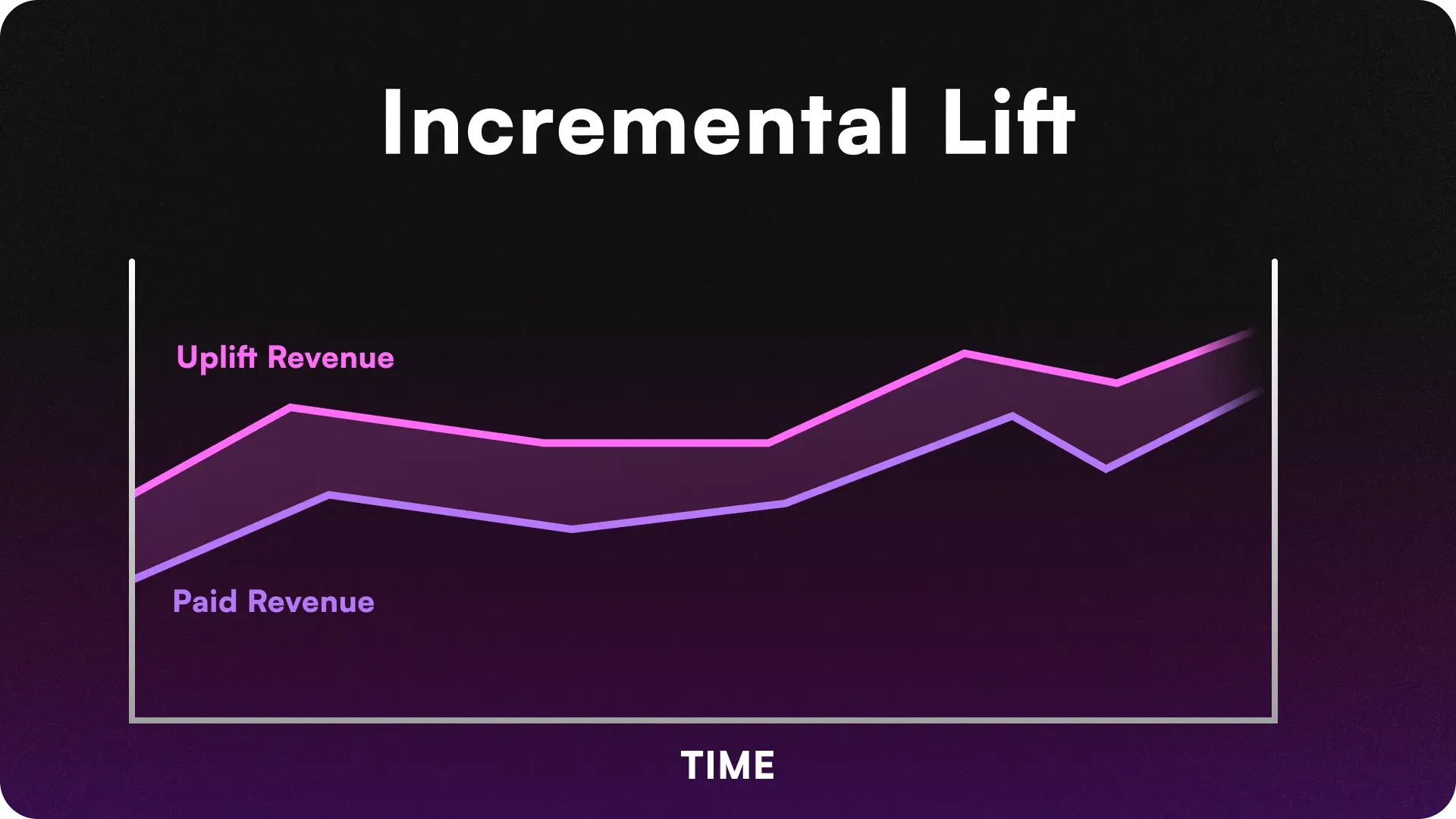
Baseline modeling across multiple channels, geos, and campaign structures quickly becomes difficult to maintain manually. We built the Upptic Growth Platform from the ground up to automatically model baseline organic traffic and measure organic uplift in real time.
Key Takeaways
- Incrementality measures the causal impact of your paid marketing, not just the attributed result.
- Organic uplift is the portion of your “organic” installs that are actually driven by paid campaigns.
- Baseline modeling separates your organic baseline from paid-driven uplift so you can accurately calculate uplift adjusted ROAS for your marketing campaigns.
- Organic uplift shouldn’t be left to guesswork. While it depends entirely on your unique product and mix, the Upptic Growth Platform automatically models it so you can scale confidently.